 Sylva Botanical Journal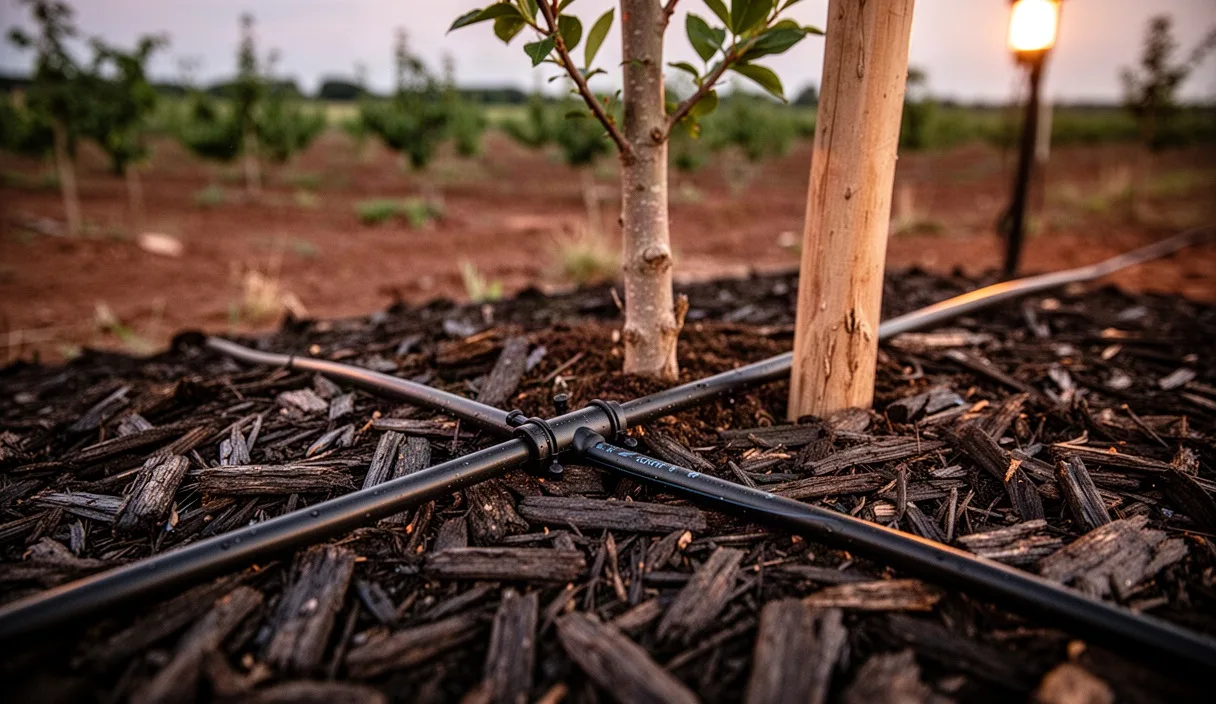

Planting woody specimens into arid clay loam requires a deliberate reconciliation between two conflicting physical states. The native soil profile possesses extraordinary mineral surface area, high microporosity, and substantial cation-exchange capacity, yet it transmits moisture with excruciating slowness. Conversely, the nursery container stock introduced to this matrix typically arrives anchored in an engineered, highly porous compost or peat blend designed for rapid drainage under overhead nursery sprayers. When an arid atmosphere imposes vapor pressure deficits exceeding 3.5 kilopascals during the midsummer months, this textural mismatch routinely leads to catastrophic sapling failure under conventional irrigation regimes.
A successful water budget does not treat irrigation as a recurring weekly event based on arbitrary calendar cycles. It operates instead as an accounting practice that measures the hydraulic conductivity of the host mineral soil against the daily transpiration loss of the developing canopy. In arid basins where annual rainfall rarely exceeds 250 millimeters, the establishment phase demands that horticulturists systematically manipulate water placement, application rates, and surface evaporation rates to encourage root egress from the container medium into the unyielding native ground.
Infiltration Capacities and Hydrology of Clay Loam
Clay loam soils typically contain between 27% and 40% clay fractions, combined with balanced proportions of silt and sand. This composition yields a dense network of interstitial micropores that exert intense matric suction on water molecules. While total water-holding capacity is high, reaching up to 180 millimeters of available water per meter of soil depth, the saturated hydraulic conductivity (known technically as K_sat) remains low. Undisturbed arid clay loam typically exhibits an infiltration capacity ranging between 2.0 and 5.5 millimeters per hour. Once the immediate surface aggregates become dispersed by droplet impact or rapid slaking, this rate can deteriorate to less than 1.2 millimeters per hour.
When irrigation application rates exceed this infiltration threshold, water ponds across the surface, initiating horizontal runoff or collecting within the loose fill of the planting pit. This latter phenomenon creates an artificial perched water table commonly described as the bathtub effect. Because oxygen diffusion through stagnant water is approximately 10,000 times slower than through air-filled pores, root respiration ceases within 36 hours of continuous saturation. The sapling then paradoxically exhibits symptoms of severe drought stress: leaf margin scorch, epinasty, and vascular collapse caused by anoxic root death rather than an absolute lack of soil moisture.
To avoid surface ponding and subsoil asphyxiation, delivery volumes must be calibrated to match the natural unsaturated hydraulic conductivity of the surrounding matrix. In arid zones, clay loam contracts into polygonal ped structures during extended dry intervals. The resulting macro-fissures initially ingest water rapidly, but as clay minerals such as smectite and illite hydrate, they swell, sealing the fissures and abruptly reducing steady-state infiltration. Irrigation pulses must therefore be metered slowly, allowing capillary action to pull water downward and laterally without overwhelming the soil surface.
| Soil Textural Class | Average Clay Content (%) | Infiltration Rate (mm/hr) | Available Water Capacity (mm/m) |
|---|---|---|---|
| Coarse Sandy Loam | 8 to 12 | 20.0 to 30.0 | 90 to 110 |
| Standard Loam | 18 to 26 | 10.0 to 18.0 | 130 to 160 |
| Arid Clay Loam | 28 to 38 | 2.0 to 5.5 | 160 to 185 |
| Dense Heavy Clay | 42 to 60 | 0.5 to 2.2 | 140 to 170 |
Calculating Evapotranspiration Deficits for Saplings
Determining the irrigation volume required by a young tree begins with reference evapotranspiration (ET_0), derived from regional meteorological station data using the standardized Penman-Monteith equation. In arid production zones, reference evapotranspiration frequently reaches 7.5 to 9.2 millimeters per day during peak solar cycles. However, because a sapling does not cover a full square meter of ground with a closed vegetative canopy, applying raw field crop values results in gross over-irrigation. The volume calculation requires the landscape coefficient method, which adjusts the reference value according to species biology, microclimate, and the physical area of the leaf canopy.
The landscape coefficient (K_L) integrates three distinct parameters: the species factor (K_s), the density factor (K_d), and the microclimate factor (K_mc). For an establishing, drought-adapted woody species such as Celtis reticulata or Pistacia chinensis, an initial species factor of 0.45 to 0.55 is common during the first year of root exploration. The density factor for an isolated specimen is typically assigned a value of 1.0, while an exposed, reflective site bordered by light-colored crushed gravel or pavement may warrant an elevated microclimate factor of 1.15 to 1.25. Multiplying these factors produces the working coefficient:
K_L = K_s × K_d × K_mc
To convert this coefficient into a liquid volume, calculate the projected canopy ground area (A) using the crown diameter. The daily water requirement in liters (V) is then determined by the formula:
V = ET_0 × K_L × A
Consider an arid site experiencing a midsummer ET_0 of 8.4 millimeters per day. A sapling with a crown diameter of 1.2 meters possesses a ground cover area of roughly 1.13 square meters. Applying a composite K_L of 0.58 yield an evapotranspiration rate of 4.87 millimeters per day for that specific footprint. Multiplied by the canopy area, this generates a net daily consumption figure of approximately 5.5 liters. Accounting for an estimated system delivery efficiency of 88% due to minor line friction and surface evaporation, the required irrigation volume stands at 6.25 liters per day, or 43.75 liters over a single seven-day cycle.
Drip Emitter Placement for Expanding Root Zones
A standard mistake in drip installation involves grouping emitters directly against the basal bark of the tree. In clay loam, the wetted pattern beneath a drip emitter assumes an oblate, horizontal bulb morphology because capillary forces outweigh gravitational forces. Water spreads up to twice as far laterally as it penetrates vertically. Placing emitters too close to the trunk maintains perpetual saturation at the root flare while leaving the periphery of the planting excavation completely parched, functionally trapping the root system within its original container dimension.
The delivery manifold must transition outward across the first three growing seasons. In year one, emitters should be positioned directly over the boundary between the container root ball and the indigenous backfill. This orientation bridges the hydraulic divide, ensuring that water enters the coarse nursery substrate while softening the surrounding clay wall to invite exploratory hyphae and root tip elongation. Pressure-compensating emitters delivering 2.0 to 4.0 liters per hour are ideal; higher output rates simply cause surface sheeting across the dense clay surface before the water can be absorbed.
- First Season Ring: Lay an inline emitter loop at a radius of 20 to 25 centimeters from the trunk collar, using three or four 2.0-liter-per-hour emitters equally spaced to provide uniform wetting throughout the nursery plug and the immediate pit wall.
- Second Season Expansion: Splice in an outer secondary ring positioned 45 to 60 centimeters from the trunk, roughly coincident with the dripline of the expanding canopy. Reduce output or clamp off inner emitters during the cooler autumn months to prevent excess moisture at the base.
- Third Season Transition: Abandon the inner ring entirely. Relocate all emission points to a broad perimeter loop situated between 75 and 90 centimeters from the trunk, extending 15 to 25 centimeters beyond the active canopy perimeter to draw feeder roots into native mineral soil.
Monitoring Soil Water Tension with Tensiometers
Volumetric water content metrics indicate how much water exists in the ground, but they do not reveal how hard a young tree must pull to extract that moisture. In clay loam, a significant portion of the total water volume is held at tensions exceeding 1,500 kilopascals (the permanent wilting point) within microscopic structural matrices, entirely inaccessible to roots. For arid management, soil water tension measured via porous-cup dial tensiometers or solid-state granular matrix sensors provides the only operationally meaningful guidance.
Tensiometers measure soil suction in centibars or kilopascals (1 cb = 1 kPa). In clay loam soils, field capacity (the point at which gravity has drained all macro-pores) resides between 12 and 22 kilopascals. Establishing saplings of drought-hardy species should be irrigated when soil tension within the active root zone reaches 55 to 65 kilopascals. If tension climbs above 80 kilopascals, vegetative elongation arrests, leaf stomata close during daylight hours, and the plant expends valuable carbohydrates producing internal osmolytes to prevent desiccation.
Accurate monitoring requires a paired-station approach. Install one shallow tensiometer at a depth of 20 centimeters to evaluate the primary root mass and detect immediate infiltration after an irrigation cycle. Install a second instrument at a depth of 50 to 60 centimeters directly below the outer root perimeter. The deep instrument acts as an environmental safeguard: a continuous low reading (under 15 kilopascals) at depth indicates that over-irrigation is saturating the subsoil and risking anoxia, whereas an excessively high reading reveals that irrigation cycles are failing to wet the full vertical depth of the pit.
Tensiometers require regular service, particularly in hot climes. Fluid columns develop air bubbles via outgassing when subjected to intense suction, requiring de-aeration with boiled distilled water and an evacuation pump every four to six weeks. If soil tension exceeds 85 kilopascals, the capillary water column within the tensiometer breaks, causing an abrupt loss of gauge pressure that demands immediate manual refilling and priming.
Mulch Architecture and Trunk Collar Preservation
Bare clay loam exposed to arid solar radiation forms a hard, indurated surface crust that impedes gas exchange and repels subsequent moisture. Applying an organic mulch blanket mitigates surface soil temperatures, which can otherwise exceed 55 degrees Celsius at midday, while dramatically curtailing non-transpirational evaporation. To optimize moisture conservation without initiating disease, the physical dimensions and spatial architecture of the mulch layer must be constructed with precision.
Fine-textured wood products, such as triple-shredded bark or sawdust, are poorly suited to arid clay loam. They decompose into an impenetrable, hydrophobic felt that absorbs modest irrigation events before moisture ever contacts the soil surface. The ideal material consists of coarse, uncomposted arborist wood chips graded between 25 and 75 millimeters in particle size. This angular matrix maintains large, free-draining air pockets that allow irrigation water and atmospheric oxygen to cascade instantly through to the mineral soil while breaking the capillary rise of subsurface water to the air.
The mulch mantle should be applied uniformly to a finished depth of 75 to 100 millimeters across a radius matching the mature tree pit, extending outward at least 1.0 to 1.5 meters from the stem. Crucially, the mulch must never contact the trunk of the sapling. Direct contact between organic mulch and the root flare creates a permanently dark, humid boundary layer. The stem bark of woody dicots lacks the suberized, microbial-resistant periderm found on true subterranean roots.
Maintain a completely unmulched buffer zone measuring 150 millimeters in all directions from the trunk flare. This protective collar prevents the structural bark from softening, thereby warding off colonization by opportunistic pathogens such as Phytophthora cactorum or wood-decaying basidiomycetes. The unmulched soil collar should be flush with or slightly higher than the surrounding basin grade to ensure that irrigation water flows outward toward the root perimeter rather than standing against the trunk base.
Common Mistakes
- Pulse-cycling at excess flow rates: Installing high-flow emitters (exceeding 8.0 liters per hour) under the assumption that short run times achieve the same results as slow percolation. High rates cause lateral run-off, leaving subsoil roots dry while crusting the surface.
- Static emitter placement: Leaving the initial nursery emitters pinned adjacent to the stem base for multiple seasons, which encourages circling trunk girdling roots and guarantees stability failure in high winds.
- Using unwashed organic fines: Spreading fine compost or shredded peat as a surface mulch, which turns hydrophobic upon drying and consumes valuable soil nitrogen as it oxidizes in hot soils.
- Irrigating on fixed clock schedules: Applying identical run-times during spring budbreak and late autumn as during midsummer heat spells, leading to severe subsoil anoxia during dormant or semi-dormant periods.
- Burying the root flare: Setting the nursery container root ball lower than the native grade to form an irrigation bowl, a practice that inevitably suffocates crown tissue under dispersed clay sediment.
Recommended Field Protocol
To implement an effective water management program for establishing trees in arid clay loam, begin by taking volumetric field samples. Use a hand auger to extract a core from a depth of 30 to 45 centimeters adjacent to the target planting sites. Roll the moist mineral fraction between your palms; if it readily ribbons to a length exceeding 35 millimeters, the clay fraction is significant, and steady-state infiltration will not exceed 4.0 millimeters per hour.
Assemble your drip layout based on calculated local ET_0 figures rather than standard nursery rules of thumb. Program the irrigation controller to execute deep, infrequent cycles separated by deliberate rest periods. A single weekly application running over a prolonged duration through 2.0-liter-per-hour emitters allows water to percolate to the desired 50-centimeter depth through capillary pull without saturating the profile to the point of hypoxia.
Install dial tensiometers within forty-eight hours of planting to verify operational assumptions. Check the vacuum readings twice weekly at sunrise before daytime transpirational pull influences the gauge. If the deep tensiometer fails to move above 15 kilopascals after two weeks of scheduled cycles, decrease the run time immediately by 20% increments until cyclic fluctuations appear. Where unique challenges arise, such as high water table salinity, shallow caliche layers, or unexpected dieback across sensitive taxa, consult a certified professional arborist or a regional soil physics specialist to perform site-specific hydraulic testing.