 Sylva Botanical Journal

The contemporary preference for high-density orchard systems reliant on clonal dwarfing rootstocks has obscured the operational mathematics once essential to standard and semi-standard pomology. When establishing orchards devoted to heritage cultivars, particularly those propagated on seedling rootstocks or vigorous clonal selections such as Antonovka, the geometric assumptions of modern spindle plantings fail entirely. A tree intended to occupy a permanent position for seven or eight decades develops an architectural footprint governed by deep taproots, broad branching angles, and significant radial volume. Determining row and inter-row intervals in these mixed plantings is less a matter of copying commercial templates and more an exercise in reconciling canopy light physics with the mechanical requirements of the orchard floor.
Mixed topologies present an additional complication. An orchard containing vigorous triploid cooking apples alongside moderately vigorous russets or spur-bearing dessert varieties cannot rely on uniform equidistant grids without wasting valuable acreage or inducing severe localized shading. The orchardist must calculate minimum row widths based on the mature canopy boundary of the most expansive specimen in the rotation, then calibrate alleyway clearances according to tractor track widths, implements, and solar interception angles. Failing to account for these variables before digging the first planting hole ensures decades of corrective, heavy canopy pruning that drains tree energy and reduces fruit yields.
Vigor Characteristics of Seedling-Origin Apple Stocks
True seedling rootstocks, traditionally derived from domestic processing waste or wild Malus sylvestris populations, possess an inherent genetic variability that complicates uniform spatial planning. Unlike uniform clonal rootstocks like M.9 or M.26, a seedling lot exhibits unpredictable vigor differentials of 15 to 25 percent between individual trees. When budded with scion varieties of differing natural vigor, these subterranean differences either compound or moderate mature crown dimensions. A naturally expansive scion like Bramley's Seedling or Gravenstein budded to an unregulated seedling base will routinely attain a mature limb spread of 32 to 36 feet in deep, well-drained loam. Conversely, cultivars with naturally upright, compact habits, such as Court Pendu Plat or Egremont Russet, rarely exceed a 22-foot spread under identical conditions.
To establish a reliable baseline for spacing, scion-rootstock combinations must be classified by canopy habit and assigned a volumetric coefficient. Upright growers (acrotonic dominance) demand less horizontal clearance but cast longer vertical shadows during the morning and afternoon hours. Spreading, weeping, or basitonic cultivars require wider row buffers to prevent mature limbs from encroaching on access lanes under the weight of mature fruit. In traditional systems, spacing calculations should assume the maximum physiological potential of the scion rather than its ten-year median size.
| Cultivar Architectural Class | Representative Cultivars | Mature Radial Spread on Seedling | Recommended In-Row Spacing |
|---|---|---|---|
| Class I: Highly Spreading / Triploid | Bramley, Gravenstein, Rhode Island Greening | 16 to 18 feet | 32 to 36 feet |
| Class II: Moderately Spreading / Diploid | Ribston Pippin, Ashmead's Kernel, Baldwin | 13 to 15 feet | 26 to 30 feet |
| Class III: Upright, Spur-Bearing | Roxbury Russet, Court Pendu Plat | 10 to 12 feet | 20 to 24 feet |
| Class IV: Tip-Bearing / Lax Habits | Belle de Boskoop, Cornish Gilliflower | 12 to 14 feet | 24 to 28 feet |
The practical consequence of this classification is that uniform row spacing across the entire parcel will yield either choked passages among the Class I trees or excessively bare ground around the Class III varieties. If planting cultivars in single varietal blocks is undesirable due to pollination or biodiversity mandates, growers must group cultivars into matched vigor rows or adjust in-row distances while maintaining a standardized inter-row centerline for machinery.
Calculating Mature Canopy Interception Angles
Light penetration through an apple canopy governs flower bud initiation for the subsequent season, peel anthocyanin synthesis, and the suppression of fungal pathogens such as Venturia inaequalis. For standard seedling trees, the internal wood tends to become unproductive when ambient photosynthetically active radiation falls below 30 percent of full overhead sun. Spacing between rows must ensure that the lower skirt of the canopy on the southern side of one row is not perpetually shaded by the upper canopy of the row to its south during the critical post-bloom window from late May to mid-July.
The geometric calculation relies on the noon solar elevation angle at your specific latitude during the summer solstice and autumnal equinox. In north-temperate latitudes (for example, 44 degrees North), the solar elevation angle at solar noon on the summer solstice is approximately 69.5 degrees, falling to 46 degrees by the equinox. To establish the minimum distance between rows oriented north to south, one applies a basic trigonometric formula:
Minimum Clear Alley Floor = Tree Height / tan(Solar Elevation Angle)
Assuming a managed standard tree height of 20 feet and using the late-season equinoctial angle of 46 degrees to protect late-ripening russets from shade:
Distance = 20 / tan(46 degrees) = 20 / 1.035 = 19.32 feet of open space between canopy perimeters
This figure represents the necessary gap between the edge of one mature tree's drip-line and the edge of the adjacent row's drip-line, not the distance between tree trunks. If Class II trees with a mature radius of 14 feet are planted, the center-to-center row spacing must equal the canopy spread plus the light buffer: 14 feet + 14 feet + 19.3 feet, yielding a center-to-center measurement of roughly 47.3 feet. In practice, orchardists manage canopy height down to 16 or 18 feet via winter pruning to reduce this required row interval to a manageable 32 to 36 feet on centers without compromising illumination on the lower fruiting wood.
Alleyway Width Formulations for Field Machinery
While light interception provides the theoretical biological optimum, mechanical access sets the uncompromising physical boundary. An alleyway that accommodates a narrow vineyard tractor in year four will become impassable by year twenty-five if calculated solely on initial planting dimensions. Standard seedling orchards require heavier machinery than dwarf plantings, particularly when deploying high-volume airblast sprayers or multi-ton bin trailers during harvest periods when ground conditions may be soft.
The total centerline inter-row distance must incorporate three specific spatial factors:
- Mature Canopy Span: The sum of the mature radius of the trees on either side of the row. For adjacent Class II trees, this equals 28 feet.
- Working Width of Implements: The physical width of the widest implement utilized, usually a flail mower or airblast sprayer, plus its dynamic sway allowance (typically tractor track width plus 18 to 24 inches on either side).
- Operator Safety and Crop Protection Buffer: A mandatory clearance zone of not less than 3.5 feet on each side of the machine path to prevent heavy structural limbs from catching tractor roll-bars, tearing foliage, or damaging low-hanging fruit spurs.
When using an orchard tractor measuring 5.5 feet in outer tire width pulling an airblast unit 6 feet wide, the clear lane between mature drip lines must be at least 13 feet wide (6 feet implement width + 7 feet total safety buffer). If paired with Class I cultivars boasting a 17-foot mature limb radius, the centerline distance expands to 17 + 17 + 13 = 47 feet. If smaller, single-axle specialized equipment is retained permanently, this operational clear zone might safely contract to 9 feet, yielding a 43-foot center for Class I, or 37 feet for Class II combinations.
Pollenizer Dispersion Across Inter-Row Spacings
Mixed heritage systems often incorporate triploid varieties that cannot pollinate themselves or any other cultivar. Cultivars such as Blenheim Orange, Bramley, and Gravenstein produce sterile pollen, requiring two distinct diploid cultivars blooming synchronously nearby to ensure both the triploid and the partner diploids set a complete crop. In wide-spaced topologies on seedling stocks, the spatial mechanics of insect flight become critical.
Solitary bees, particularly the blue orchard bee (Osmia lignaria), and feral honeybees (Apis mellifera) prioritize efficiency by working along the row rather than crossing open, wind-exposed alleyways. If the inter-row space exceeds 28 to 32 feet, insect movement between rows drops precipitously on cool or windy spring mornings. Consequently, relying on a pollenizer cultivar situated three rows away is an architectural error that leads to biennial bearing and uneven fruit set.
- In-Row Staggering: Place a diploid pollenizer within the row itself at regular intervals. For plantings dominated by triploids, every third or fourth tree in the row should be a compatible diploid.
- Opposing Alley Placements: If diploid cultivars are segregated into dedicated rows for ease of harvesting, avoid solitary pollenizer rows. Instead, plant paired rows of complementary diploids alternating with paired rows of triploids.
- The 60-Foot Proximity Radius: Under sub-optimal foraging weather, bumblebees and solitary bees forage within a restricted zone. No point within the canopy of a cropping tree should stand further than 60 linear feet from a compatible pollen source.
Where wide row layouts must be preserved for heavy field equipment, introducing crabapples (Malus floribunda or 'Golden Hornet') directly into the primary tree line serves as a space-efficient countermeasure. These trees can be pruned to an upright, columnar profile, fitting neatly between standard planting stations without demanding additional row width.
Adjusting Spacing for Future Understory Management
The ground beneath standard seedling orchards cannot be maintained as bare earth or simple herbicide strips without precipitating severe soil erosion, moisture loss, and organic matter depletion. The spatial design must account for the planned understory regime, whether it involves silvopastoral grazing, non-inversion mechanical cultivation, or perennial perennial polycultures. Each system imposes distinct physical boundaries on the lowest structural branches and the clear distance between tree lines.
If sheep are to be grazed within the orchard to manage the sward and recycle windfall nitrogen, trunk clearance must be maintained through early pruning to a scaffold height of at least 5.5 feet. This elevated canopy architecture permits animals to pass beneath the limbs without damaging vegetative buds. However, this vertical lift also widens the effective solar footprint on the orchard floor, enabling narrower alleyways without risking excessive shade on the lower tiers of the canopy.
Conversely, if the understory is dedicated to mechanical haymaking or permanent living mulches such as comfrey, white clover, or creeping red fescue, the row geometry must accommodate the harvesting hardware. A common mistake is sizing the alley to the tractor frame while forgetting the sweep of an offset mower or side-delivery rake. A minimum buffer of 48 inches must remain between the outer edge of an understory mower deck and the tree trunk to prevent trunk girdling by equipment wheels, even when the tree is protected by a timber guard.
Common Pitfalls in Heritage Spatial Design
The most pervasive error in establishing standard heritage orchards is designing the layout based on the equipment and trees present at year five. At five years of age, seedling trees appear dwarfed by their generous 30-foot intervals, tempting the orchardist to interplant temporary filler rows or encroach upon the machinery alleys. When the trees enter their third decade of growth, these short-sighted interventions result in an impenetrable thicket that prevents cross-orchard air drainage and invites chronic scab and mildew infestations.
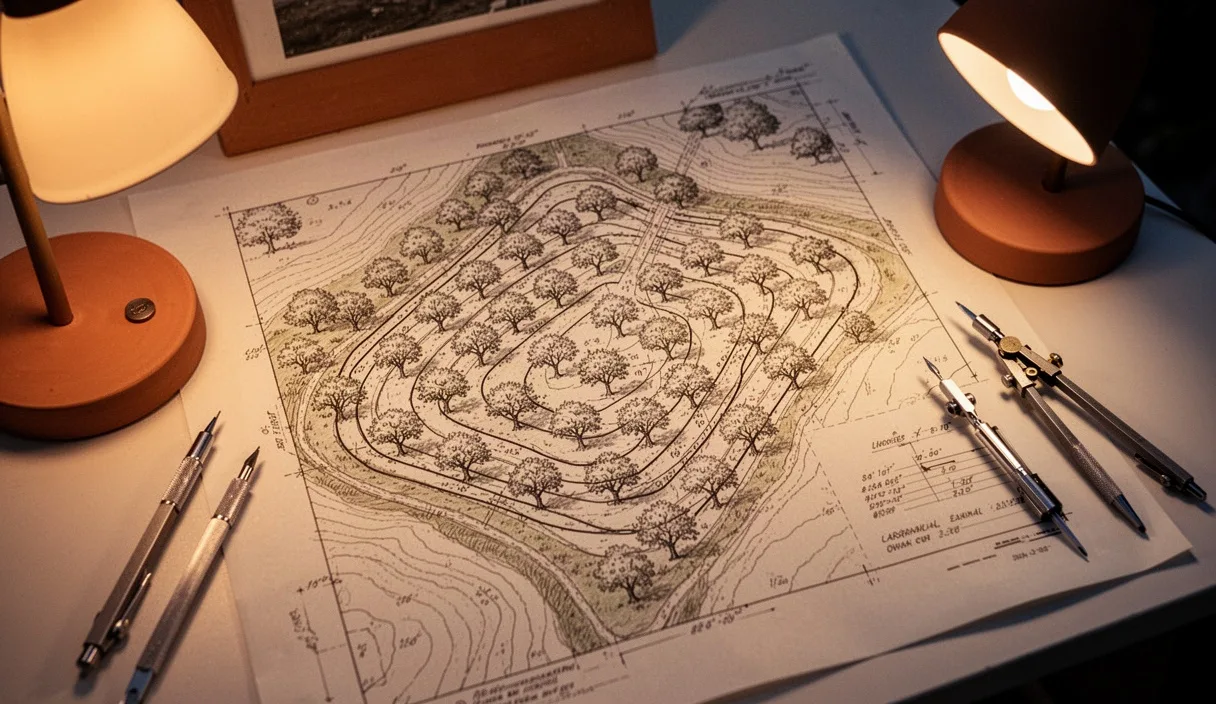
A secondary oversight involves neglecting the topographical slope. When rows are run along contours to mitigate soil erosion on hillsides, the lateral tilt of the tractor causes the top of the machine or its exhaust stack to lean significantly toward the downhill tree row. On an eight-degree slope, a tall cab tractor can easily list 12 to 16 inches off its vertical centerline, bringing it into destructive contact with primary scaffold branches that would otherwise clear a level corridor. In sloping sites, inter-row calculations must be broadened by a minimum of 10 to 15 percent beyond flat-ground baselines.
Implementation Schedule and Site Preparation
Transitioning from mathematical planning to ground layout requires a systematic sequence of operations conducted well before bare-root nursery stock arrives in late autumn or early spring. Hasty surveying in wet, poorly prepared ground invariably introduces small layout errors that compound across wide grid networks.
- Soil Profile and Water Table Assessment: Dig test pits across the planting site down to five feet. Identify impermeable clay pans or seasonal high water tables. Seedling stocks send down substantial taproots; encountering an impenetrable layer at 24 inches will alter root morphology from vertical to lateral, effectively widening the mature crown spread by 10 to 20 percent.
- Baseline and Benchmark Sighting: Establish a primary baseline running parallel to the longest unobstructed boundary or directly on a true North-South solar axis using a surveyor's transit or high-precision optical square. Avoid relying on perimeter hedgerows or boundary fences, which are rarely plumb.
- Machinery Dry Runs: Stake out three consecutive rows at the calculated intervals using plain wooden survey markers. Drive the widest intended equipment through the staked aisles, including implements with three-point attachments lowered and raised, to visually confirm that turning radii at headlands are fully adequate. Headlands for seedling orchards must measure at least 30 to 35 feet to allow a heavy tractor and wagon to execute a turn without multiple-point reversals.
- Permanent Layout Marking: Drive semi-permanent ground stakes at every tree station. In mixed-vigor topologies, mark stakes with weather-resistant color codes corresponding to the architectural vigor class (Class I through IV) to prevent low-vigor scions from being mistakenly placed into wide positions, and vice versa.
Where extensive topographical adjustments or specialized sub-surface drainage systems are required, growers should consult an agricultural engineer or certified orchard spatial planner before final field staking. Structural adjustments are practically impossible to reverse once a taproot-anchored heritage tree reaches its second decade in the soil.