 Sylva Botanical Journal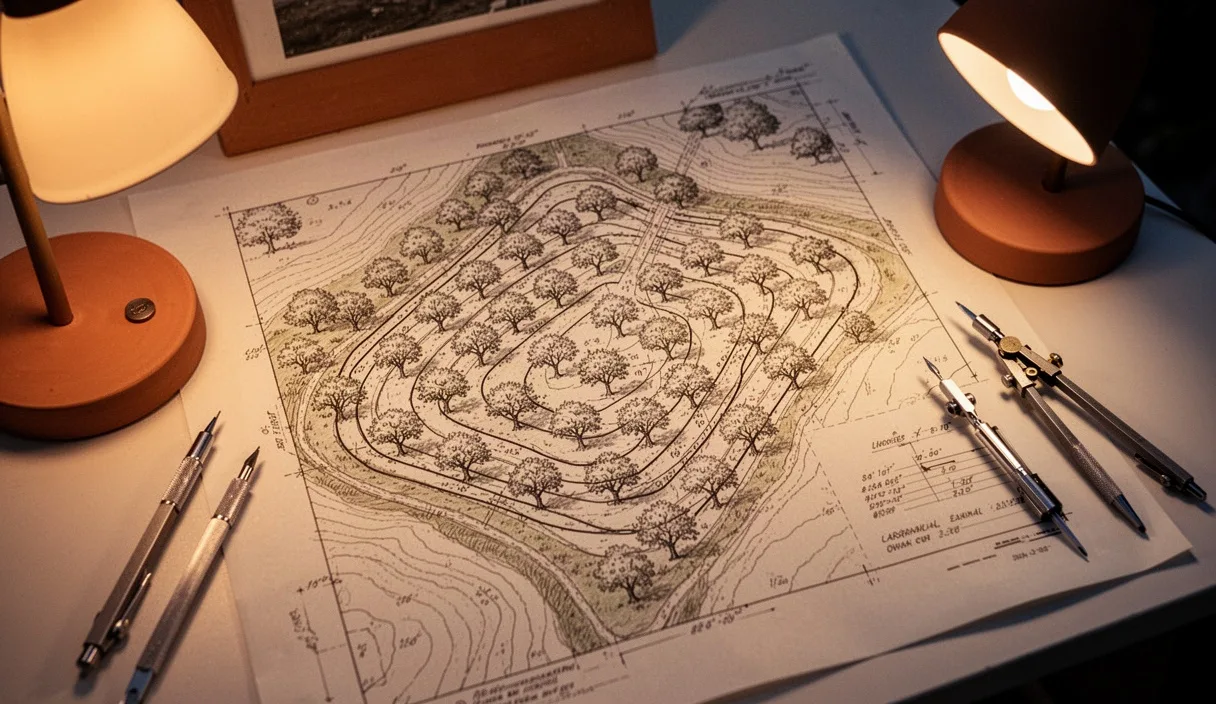

Topographical heterogeneity introduces complications that standard grid-based orchard designs are ill-equipped to resolve. When land falls across undulating terrain, uniform row spacing and rigid north-south orientations often run headlong into localized frost pockets, severe hydraulic erosion, or machinery instability. The pomologist or estate planner must abandon the geometric simplicity of flat-ground layouts in favor of an approach that treats slope angle, aspect, and airflow as interconnected physical constraints.
A successful design balances photosynthetic capture against microclimatic hazard and daily operational efficiency. Siting an orchard on variable ground requires reading the landscape as an active system: cold air behaves much like viscous fluid, solar radiation varies considerably across opposed faces of the same knoll, and tractor stability deteriorates rapidly once lateral slope thresholds are exceeded. Addressing these realities prior to planting is substantially cheaper than attempting to remediate frost damage or re-grade washing topsoil five seasons later.
Evaluating Cold Air Drainage and Katabatic Flows
Nighttime radiative cooling causes air adjacent to ground vegetation to chill rapidly, increase in density, and flow downward along topographic gradients. These katabatic winds, while generally gentle (often moving at velocities between 0.3 and 1.8 meters per second), carry substantial masses of dense air toward lowest points in the landscape. If this descending volume meets an obstruction or an enclosed depression, it settles into an inversion pool. In early spring, during bud break and bloom, such pooling causes bud mortality that can eliminate an entire crop overnight.
Mapping these patterns requires identifying both the macro-topography of the wider catchment and the micro-topography of the specific block. High ridges shed cold air effectively, creating an intermediate thermal belt along the mid-slope where minimum night temperatures can be 3 to 6 degrees Celsius warmer than the valley floor below. The upper boundary of this thermal belt is limited by wind exposure on exposed crests, whereas its lower boundary terminates at the ceiling of the cold air reservoir. Planting stone fruits or early-leafing pome cultivars in this mid-slope zone minimizes the operational costs of active frost protection.
To analyze potential flow paths without expensive LIDAR modeling, one can observe physical indicators across the site before clearing or earthworks commence:
- Dense natural stands of frost-tolerant native species (such as certain sedges or willows) typically delineate the boundaries of chronic frost sinks.
- Convex landforms (spurs and noses) diverge cold air, dispersing it safely down lateral flanks, whereas concave forms (draws and swales) converge and accelerate katabatic currents.
- Hedgerows, stone walls, and road embankments running perpendicular to the fall line act as subterranean dams, trapping deep pools of cold air on their uphill sides.
Where cold air paths funnel through narrow gaps between landforms, the velocity of the air mass increases, but so too does its scouring effect. Trees planted directly within these drainage channels often experience mechanical desiccation and erratic pollination, as bees avoid flight in cold, channeled drafts exceeding 2.5 meters per second.
Contour Keyline Mapping for Variable Gradients
When the fall line of a slope varies between 4 percent and 18 percent over short horizontal distances, straight rows invite catastrophic erosion along tractor wheelings and bare strips under herbicide or tillage regimes. Adapting the Keyline system, developed originally by P.A. Yeomans, allows tree rows to distribute surface runoff from wet, converging valleys out toward drier, convex ridges. The primary objective is to alter the natural hydrology so that water slows, infiltrates, and resists consolidation into destructive rills.
The layout begins with identifying the keypoint, which is the point of inflection in a primary valley where the profile transitions from convex (erosional) to concave (depositional). A keyline surveyed through this point across the property serves as the baseline for row alignment. By running tree rows parallel to this contour line, both above and below it, the tractor passes and swales guide rainfall away from the gully centers and spread it evenly across the broader faces of the slope.
| Gradient Class | Maximum Row Run Length | Inter-Row Floor Management | Erosion Risk Profile |
|---|---|---|---|
| 0 to 4 percent | 400 meters | Mowed sod strip or alternate tillage | Negligible; ponding possible in depressions |
| 5 to 9 percent | 250 meters | Permanent perennial sod, clovers or creeping red fescue | Moderate; sheet wash along herbicide strips |
| 10 to 14 percent | 150 meters | Undisturbed sod; organic mulches under tree lines | High; gullying in tractor tracks |
| 15 percent and above | 80 meters (or terraced) | Deep-rooted sod mixes; structural water-diversion swales | Extreme; lateral machinery slippage likely |
Because natural contours are rarely parallel, spacing between contour rows will inevitably wander. On variable ground, planners must incorporate point rows, which are truncated rows inserted into areas where the distance between two primary contour rows exceeds twice the standard equipment width. Leaving excessive open ground invites weed colonization, while compressing row widths below machinery clearance guarantees trunk and branch damage during spray passes.
Solar Interception Adjustments for Row Orientation
In high-density dwarf orchards, a north-south row orientation is standard practice on level terrain, as it provides roughly equal daily exposure to both sides of the canopy. However, on terrain characterized by pronounced aspects, adhering dogmatically to a north-south axis can severely penalize productivity or exacerbate physiological disorders such as sunburn. A southern aspect (in the Northern Hemisphere) absorbs far more shortwave solar radiation during midday than a northern aspect, warming the soil early in the spring and advancing bud break by up to two weeks.
On steep east-facing slopes, the morning sun hits canopies when air temperatures are still low, promoting rapid drying of dew, which suppresses fungal pathogens such as apple scab (Venturia inaequalis). Conversely, west-facing slopes experience peak solar radiation simultaneously with peak ambient air temperatures in mid-afternoon. Rows aligned north-south on an eight-degree west-facing slope frequently suffer from fruit skin scald, particularly on red-fruited apple cultivars where canopy interior temperatures can exceed 42 degrees Celsius under still air.
To balance light interception against the slope vector, calculate an offset angle from true north. On moderate northwest or southwest aspects, rotating the row orientation up to 35 degrees toward the northwest or northeast moderates the solar load on the fruit surface. The target light interception for high-yielding planar canopies, such as spindle or multileader systems, falls between 65 percent and 72 percent of available photosynthetically active radiation (PAR). Deviating from this range through poor aspect alignment either starves lower fruiting wood of renewal light or exposes ripening fruit to thermal degradation.
Integrating Equipment Access and Turning Headlands
Theoretical planting plans often fail at the margins, where heavy tractors and trailed sprayers must turn safely. A loaded air-blast sprayer carrying 1,500 liters of water shifts its center of gravity continuously. Turning such equipment on a slope requires wide, stable headlands with gradients significantly gentler than the main orchard rows. If headlands are squeezed to maximize tree density, operators will inevitably roll tires over the edges of terraces or slide during wet early-season applications.
Headland design must account for the turning radius of the largest machinery anticipated over the 25-to-30-year lifespan of the orchard. A standard four-wheel-drive narrow orchard tractor with a towed sprayer requires a minimum turn radius of 6.5 to 7.5 meters to transition smoothly from one row to the next without dragging the inside implement wheel or jackknifing the PTO shaft. On slopes above 7 percent, this turning buffer should be widened to 8.5 meters to allow the operator to brake and square up before entering the new drive alley.
- Grade the headland to maintain a cross-slope of less than 3 percent, directing any surface runoff into a grassed waterway rather than down the adjacent tree rows.
- Establish deep-rooted turfgrass varieties, such as tall fescue (Festuca arundinacea), across the entire turning zone at least one full season before tree establishment to ensure load-bearing capacity.
- Install solid turning pads or crushed-rock transitions at terminal row ends where machinery must traverse soft drainage zones.
- Anchor the end posts of trellis systems at an angle of 60 degrees, setting the ground anchor back at least 1.2 meters from the drive path to prevent implement snags.
Furthermore, internal access alleys should cross the contour at regular intervals, typically every 100 to 120 meters along the row run. These intermediate corridors allow harvest crews to extract bins without dead-heading several hundred meters along a steep side-slope, reducing both soil compaction and tractor turnaround time.
Placing Windbreaks Without Creating Stagnant Air Pools
High winds reduce tree growth, bend young leaders, reduce the foraging activity of pollinating insects, and cause fruit russeting or limb rubs. Planting shelterbelts is the standard mitigation, yet an improperly placed windbreak on a sloped site acts precisely like a dam in a river. If an evergreen hedge is placed across the lower boundary of an orchard block, it catches descending katabatic flows, backing cold air up into the lower rows and forming an artificial frost pocket where none existed previously.
Effective shelter design on undulating terrain relies on managed porosity. A living windbreak should have an optical porosity of roughly 40 percent to 50 percent, distributed evenly from ground level to canopy top. This density slows incoming winds without forcing them to accelerate over the crest or creating a turbulent low-pressure wake on the leeward side. To avoid trapping cold drainage air, the lower 1.0 to 1.5 meters of the windbreak should be pruned clear of dense foliage, or deciduous species should be selected so that the screen opens up during the dormant and early flowering periods when frost risks are highest.
Deflection Belts on Slope Margins
Where cold air drains from higher ground off the property, windbreaks should be aligned at an angle of 45 degrees to the fall line. This orientation deflects the descending cold stream around the perimeter of the orchard blocks, guiding it safely toward natural drainage paths or roads below. Dense, multi-row plantings of conifers should be reserved exclusively for the crest of the hill to break prevailing synoptic winds, never for the mid-slope benches or valley bottoms.
Gap Management and Drainage Outlets
If continuous windbreaks already exist across the lower margins of a block, deliberate gaps must be cut to allow cold air to escape. A gap of 10 to 15 meters width, aligned with the lowest topographical depression, allows cold air to exit the block freely. If wind penetration through this gap poses a danger during storm events, a baffle hedge planted 15 meters downslope of the opening can diffuse incoming gusts while maintaining an open channel for gravitational air drainage.
Common Mistakes
Layout errors on sloped sites are durable, expensive, and physically disruptive to rectify once support posts and irrigation mains are buried. The following errors occur with regularity:
- Sinking mainlines in natural valleys: Burying main distribution pipes along the center of drainage draws places them directly in the path of flash runoff, where erosion routinely excavates or breaks subterranean lines.
- Ignoring lateral tractor tilt: Setting rows straight across a side-slope without terracing forces equipment to operate at a permanent lean. At angles over 11 degrees, operating high-clearance vineyard or orchard sprayers becomes dangerous, and application patterns become asymmetrical.
- Trapping air behind solid deer fencing: Plastic or wire perimeter fencing, when clogged with blown leaves, dead grass, or snow, acts as a surprisingly effective dam for katabatic currents. Ensure bottom wire clearances allow unobstructed air drainage at low ground exit points.
- Overestimating early light on east slopes: Assuming east slopes are inherently safe from frost; early morning sun hitting frosted buds causes rapid cell thawing, which ruptures plant cell walls more severely than slow thawing on northwest slopes.
Practical Next Steps
Before ordering plant material or breaking ground, develop a coherent site map based on empirical observations rather than desktop estimations alone. The following sequence establishes the groundwork for an enduring installation:
Acquire a high-resolution elevation model of the parcel, ideally generated via drone-mounted photogrammetry or RTK-GPS surveying, yielding contour intervals no coarser than 0.5 meters. During the spring preceding planting, deploy a network of minimum-recording thermometers or miniature data loggers across the terrain. Position them at a standard height of 1.5 meters across high points, mid-slopes, valleys, and above existing hedgerows to capture nocturnal inversion behaviors under clear, windless conditions.
With topographic and thermal maps in hand, engage a professional agricultural engineer to verify hydraulic calculations for swales and waterways. Determine the precise Keyline or contour offsets based on the turning radius of your machinery fleet, then mark the key points and row centerlines with high-visibility stakes. Excavate deep inspection pits across the site to confirm that variable slope angles have not resulted in truncated, shallow topsoils on the ridges or impenetrable clay lenses in the depressions. Only when the hydraulics, air pathways, and machinery geometries are reconciled should the post-hole driver enter the field.